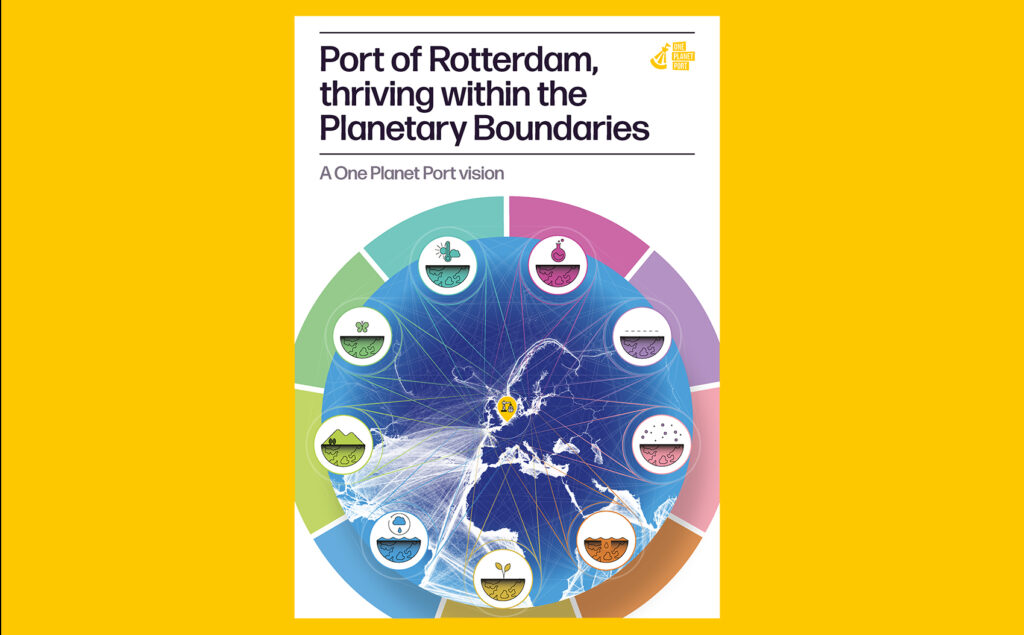
The One Planet Port Vision Report is our first major milestone – a concrete, scientific, fully worked-out answer to how one of the world’s largest ports can truly transform. Not with isolated measures or fine words, but with a fundamentally different view of what a port is and what it moves through the world. The report looks at the full picture: climate, nitrogen, biodiversity, plastics, communities, jobs, and long-term economic resilience – all within the framework of planetary boundaries. It is not an endpoint. It is a starting point. From here, we build the roadmap. The planet cannot wait. Neither should Rotterdam.
The report reveals a pattern of broken promises, missed opportunities and delayed action. These are ten examples.
- Maasvlakte 2 – compensation promise ignored for 14 years. 2,455 hectares of Natura 2000 habitat sacrificed. The promise to compensate with 25,000 hectares of Voordelta was only honoured after a laborious case, and court ruling in 2022. Serious questions remain about the credibility of promises around a potential Maasvlakte 3.
- Rotterdam already exceeds the NO₂ limit scheduled to come into force in 2030.The annual average concentration in 2024 was 20.4 µg/m³ – above the European limit of 20 µg/m³ that only applies from 2030.
- 0% of surface water meets EU ecological standards. Only 6% meets chemical standards. Not a backlog – structural failure.
- Scrubbers clean the air by polluting the water. Open-loop scrubbers account for 98% of all water discharges from ships – including heavy metals and carcinogenic substances. Rotterdam facilitated this system for years while Antwerp and Hamburg had already introduced bans.
- The nitrogen crisis – 18,000 projects suspended. The port contributed substantially to nitrogen pollution, but long avoided the consequences felt by farmers and construction workers.
- PFAS is found in virtually every person. Forever chemicals detected in the blood of virtually all Dutch residents. The port plays a central role in the import and distribution of these substances.
- Drinking water shortages projected before 2030. The RIVM warns of shortages in all regions. Dozens of companies have already been denied water connections. Water reduction targets are not being met.
- Nitrogen deposition falling far too slowly. The Netherlands achieved only 9% reduction between 2005 and 2022 – well below the EU average of 13% and far from the 2030 target of 25%.
- Shipping emissions are rising while climate targets draw closer. Maritime NOx climate warming emissions in the EU rose 10% between 2015 and 2023 – in the Atlantic region by as much as 33%. Stricter standards only apply to new ships.
CCS is a smokescreen for delayed emissions reduction. The total storage capacity of Porthos – 37 megatons over 15 years – covers less than three years of Dutch national emissions. CCS is being used to justify postponing real systemic emissions reduction.
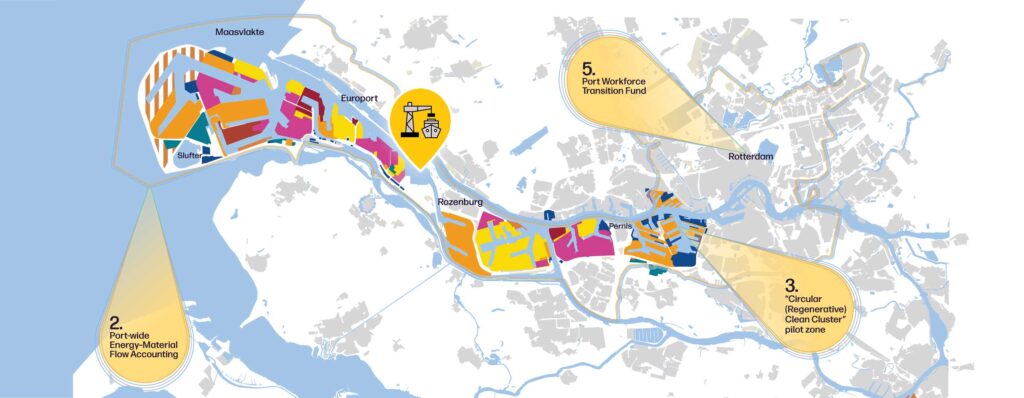
Every problem is also an opportunity. In our Vision Report, One Planet Port shows what is possible. Six opportunities Rotterdam can seize right now.
- Make ecological performance an access criterion. Anyone wanting to operate in the Port of Rotterdam must demonstrate that their activities fall within planetary limits – for climate, nitrogen, biodiversity and chemical pollution. Not as an ambition, but as a condition.
- Replace fossil transit with circular industry. Rotterdam has the space, the infrastructure and the knowledge to become one of the world’s largest circular industrial clusters. Zero oil and coal in, more raw materials used again and again.
- Make the port’s true footprint visible. Publish a full energy and materials flow account – including everything that passes through, not just direct emissions. Only that which is measured can be improved.
- Accelerate shore power and zero-emission bunkering. Ships berthing in port consume enormous amounts of energy and emit while standing still. Rotterdam can set the standard by making shore power mandatory and rolling out clean fuel infrastructure at speed.
- Establish a port-wide transition fund for workers. The energy transition changes which jobs exist. A fund that retrains and supports workers makes the shift a just one – and prevents the burden falling disproportionately on those on the shop floor.
Become the home port of tomorrow’s clean strong economy. Companies that operate circularly and sufficiently, use clean fuels and are transparent about their footprint are looking for berths that match their ambitions. Those companies are prospering. By creating the right conditions now – infrastructure, regulation, knowledge – Rotterdam attracts exactly the sectors that will shape the economy of the future. Not in spite of the transition, but because of it.
The Vision Report is available to read and download in full (40MB). We welcome responses from researchers, policymakers, port businesses, journalists and anyone who believes Rotterdam can do better – and wants to help make it happen.
Join the Newsletter
Subscribe to our newsletter to receive periodic updates on our initiatives, including invitations to upcoming events, progress on our key projects, and notifications about newly published reports and insights. Be part of our journey toward a sustainable and zero-pollution Port of Rotterdam.
Send Us a Message
Have questions? Fill out the form below and we’ll get back to you as soon as possible.
