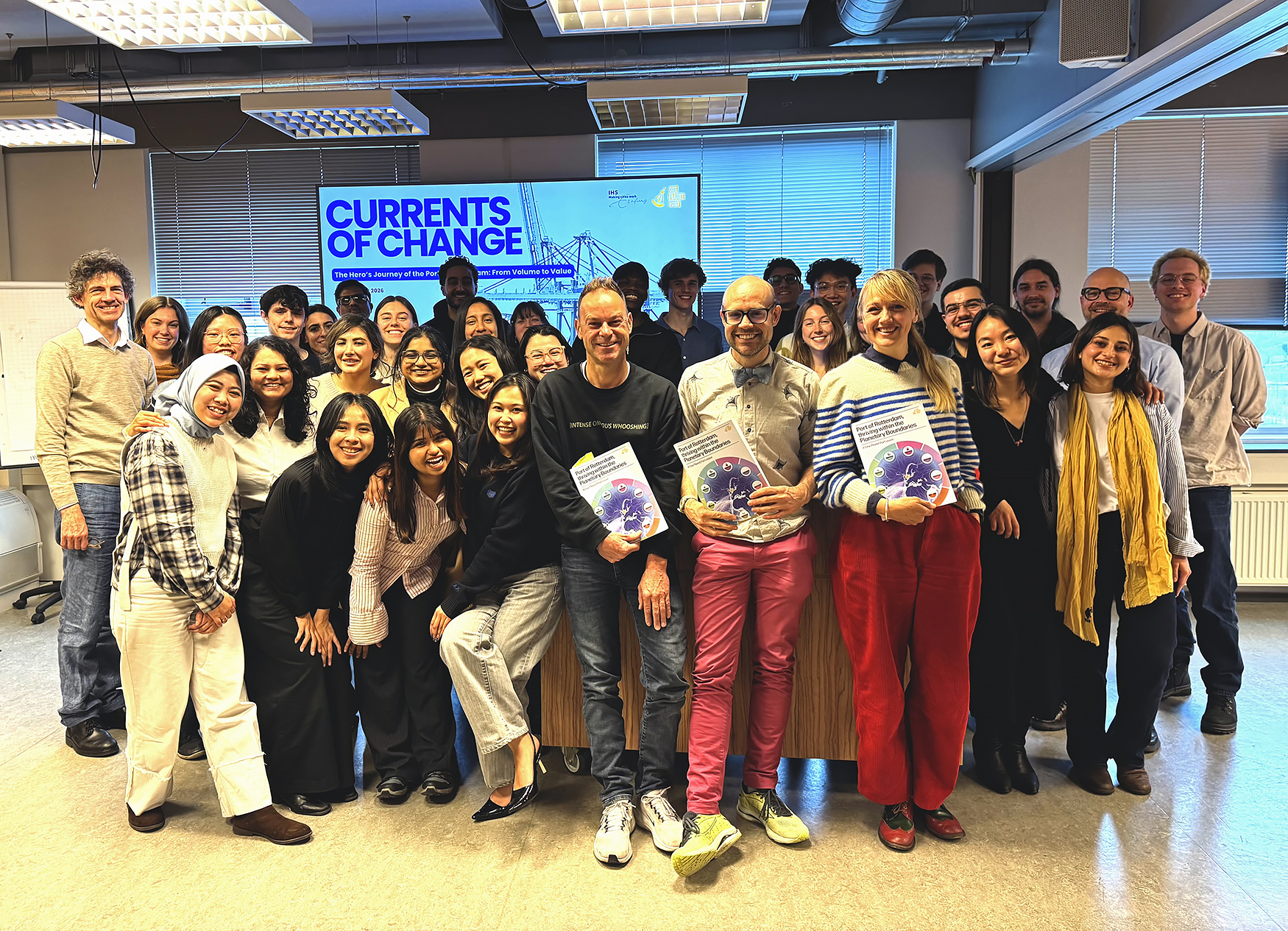
How can one of Europe’s largest and most complex ports transform itself to operate within planetary boundaries – without sacrificing economic strength or social equity? That was the central question a group of 30 master’s students from the Institute for Housing and Urban Development Studies (IHS), Erasmus University Rotterdam, took on as a seven-week advisory assignment for One Planet Port. Supervised by Alexander Los and Paul Rabé – both Assistant Professors at IHS specialising in urban environment, climate change and urban governance – the students presented their findings on Friday 27 March. Representing 21 nationalities and 12 disciplines, they had focused their research on nitrogen as one of the port’s most pressing planetary boundary challenges.
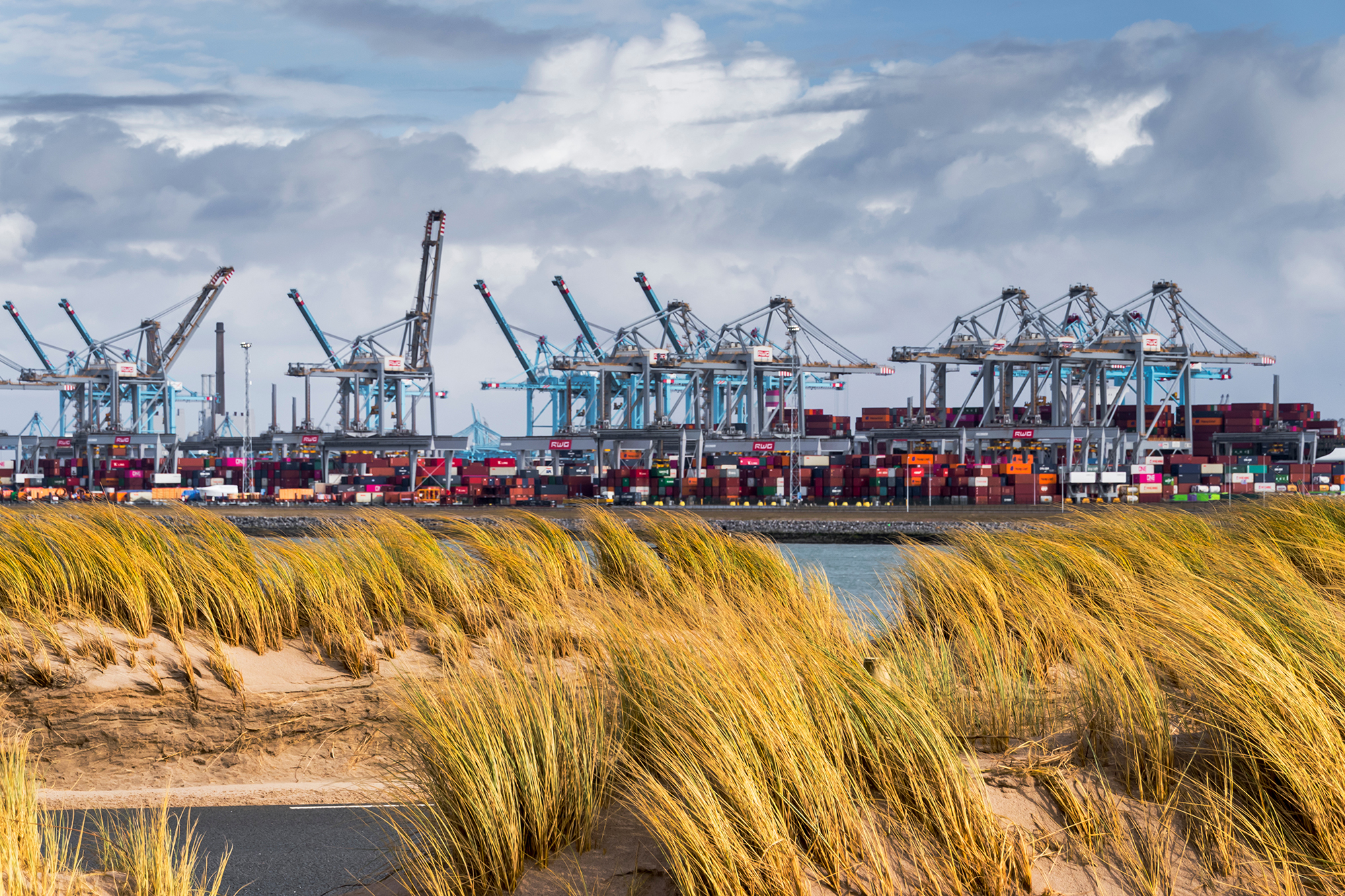
Their work, titled “Currents of Change: The Hero’s Journey of the Port of Rotterdam – From Volume to Value,” zeroed in on shipping as the dominant source of nitrogen pollution in and around the port – responsible for problematically high concentrations of NOx (nitrogen oxides comprised of NO and NO2), these gases are formed during fuel combustion – the primary nitrogen oxide is produced by burning fuel at high temperatures – reacts with ozone in the surrounding atmosphere to form NO2. At elevated levels NO2 damages human airways – especially in children and the elderly – while also forming acid rain and smog, and over-fertilising waterways in ways that deplete oxygen and kill aquatic life. Framing the nitrogen crisis not as a dead end or an issue to be ignored by politicians in favour of prioritising economic interest but as a catalyst for transformation, the students argued that the port’s public ownership, its economic heft, and the determination of Rotterdammers represent an untapped combination of assets. Their central proposition: a shift from being the “world’s busiest” port to becoming the “world’s smartest and safest.”
Their recommendations spanned technical, social, and governance dimensions. On the technical side, they proposed retrofitting ship engines with Selective Catalytic Reduction (SCR) technology – a mature, well-tested system already used in trucks and power plants worldwide, which works by spraying a harmless urea solution into a ship’s exhaust and triggering a chemical reaction that converts a group of nitrogen oxides (NOx), of which primarily nitric oxide (NO), into ordinary nitrogen gas (N2) and water vapour. Applied to shipping, it can cut NOx emissions by up to 90% under optimal conditions. Further proposals included the development of Nutrient Recovery Centres to capture nitrogen from ship exhaust waste streams, just-in-time logistics to reduce idle time and emissions, and the integration of wetlands and nature-based solutions as active nitrogen sinks and coastal defences. On the governance side, the students called for bottom-up participation, a Port Workforce Transition Fund to protect the port’s 182,000 jobs, and a stronger role for community-led monitoring initiatives like De Luchtclub, a Rotterdam-based citizen network that measures air quality in the city.
The presentation at IHS made for an energetic and constructive session. The exchange between the student consultants and the OPP team was genuinely enthusiastic – a reminder of what fresh, multidisciplinary thinking can bring to complex challenges like this one.