One Planet Port exists to halt and reverse ecological breakdown facilitated by global maritime material flows and ports. We pursue this by co-developing and deploying the pathways that bring ports and the global maritime system to operate within ecological limits, the nine planetary boundaries that together define a safe operating space for humanity (Stockholm Resilience Centre, 2025). The nine planetary boundaries model frames everything we do.
Think of Earth as having a kind of built-in life-support system. A set of natural processes – a stable climate, healthy forests and wildlife, clean freshwater, breathable air, and more – that quietly keep the planet livable. Scientists have identified nine of these critical systems and worked out roughly how much pressure each one can take before it risks tipping into dangerous, hard-to-reverse change. Together these limits mark out what researchers call a “safe operating space” for humanity – essentially a set of guardrails that let people and nature thrive for generations to come (Rockström et al., 2009; Stockholm Resilience Centre, n.d.).
The nine boundaries cover climate change, the health of plant and animal life, land use, freshwater, the balance of nutrients like nitrogen and phosphorus, the acidity of the oceans, tiny airborne particles, the protective ozone layer, and human-made pollutants such as plastics and synthetic chemicals. They’re all connected, so pushing past one can place extra strain on the others. The concern today is real: recent assessments find that seven of the nine boundaries have already been crossed, meaning we are operating outside the planet’s safe limits in most of these areas (Planetary Health Check, 2025). The framework’s value is that it gives us a clear, science-based picture of where we stand – and where we need to ease the pressure (Gilliam et al., 2026).

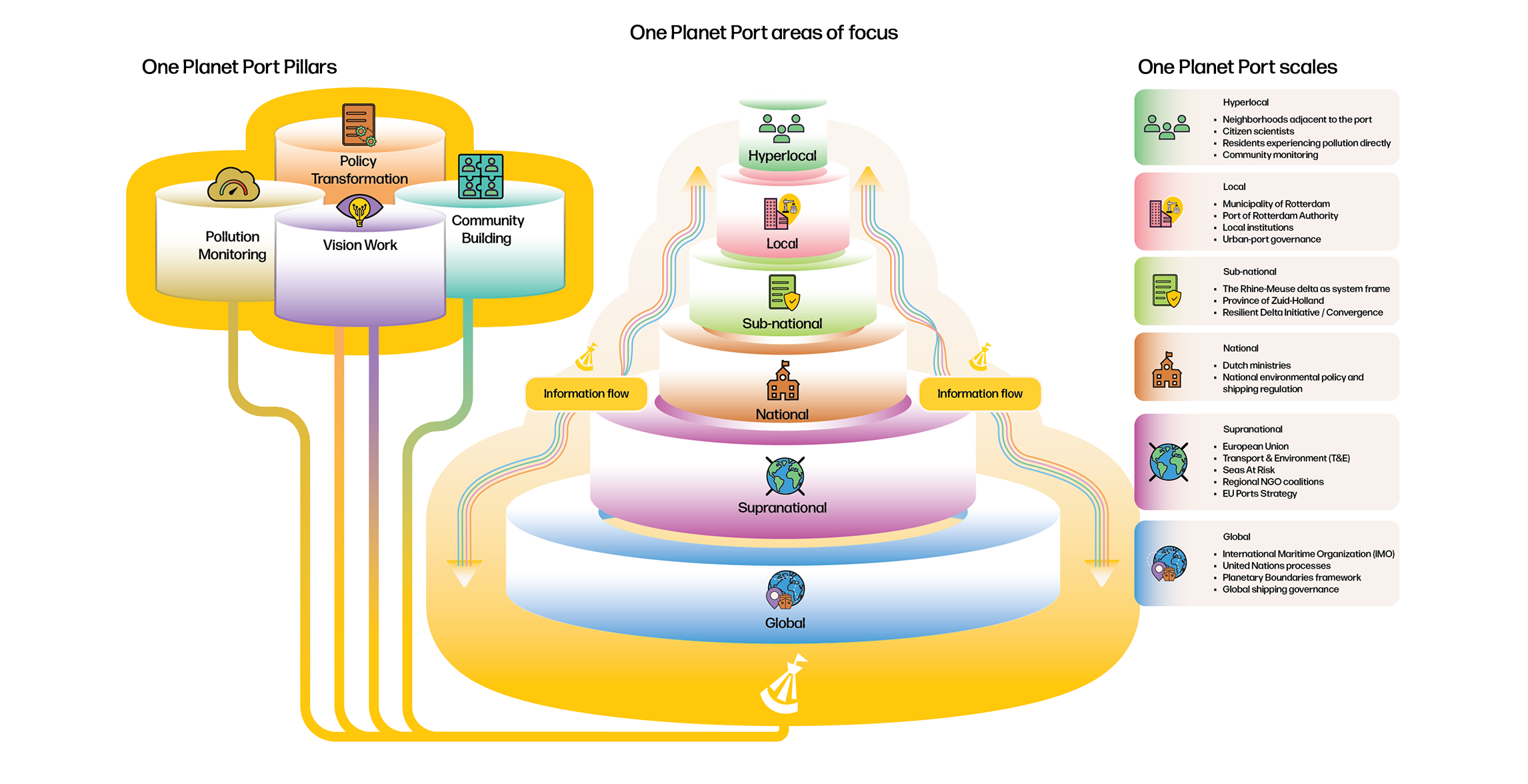
Vision Work
We develop science-based visions for how ports can operate within all nine planetary boundaries – not climate alone. Through research, systems analysis, storytelling, workshops and strategic frameworks, we translate planetary boundaries science into practical transition pathways for ports moving away from today’s ecologically overshooting economic model to a sufficiency model.
Community Building
We bring together residents, researchers, NGOs, policymakers, workers and cultural actors to build collective capacity for port transformation – cultivating shared ethical commitment to what a truly sustainable and just port system should look like. Lasting change requires democratic engagement, not just technical solutions.
Pollution Monitoring
We coordinate community-centred pollution monitoring initiatives focused on the environmental and public health impacts of ports and shipping. Combining citizen science, academic collaboration taking into account environmental and social justice, we work to understand how industrial port activity affects the people and ecosystems close to it.
Policy Transformation
We engage across multiple governance scales – from the IMO and EU policy processes to Dutch national policy, Rotterdam city governance and hyperlocal community initiatives – to help align decision-making with the realities of planetary boundaries, ecological limits and long-term well-being.
A truly sustainable port is not just a more efficient port. The most important question is not how to do things more cleanly, but whether certain activities should exist at all within planetary limits. This principle of sufficiency underpins everything One Planet Port does; combined with circularity and efficiency, it forms the analytical backbone of our work, a framework that asks not only how the port operates, but what it moves through the world, and at what cost to people and planet.
This hierarchy is how we turn that principle into action: the levers for bringing ports back within the nine planetary boundaries, ordered by impact. Demand reduction comes first because it is the most powerful; nature-based solutions, efficiency and circularity follow in support of it, never as substitutes.

Step 1: Demand Reduction
The most powerful lever for reducing the planetary impact facilitated by maritime ports is by reducing what flows through it, e.g., phasing out fossil-fuel cargoes, curbing virgin and extractive raw materials, and scaling back non-essential, high-impact consumer goods, while shifting the remaining mix towards essential, low-impact, reused and circular flows. Because ports handle the overwhelming majority of global merchandise trade by volume, the pressures they channel are not confined to their fence line: the embedded impacts of producing goods, the supply-chain impacts of moving them, and the impacts of their use and disposal cascade across global value chains and typically dwarf a port’s direct operational emissions by several orders of magnitude (OPP, 2026).
This is why port throughput, not just port operations, must be the central object of port transformation. There is no credible pathway to halting and reversing ecological breakdown without an absolute reduction in material throughput, and that absolute reduction is precisely what delivers the reductions in embedded throughput impacts (extraction, production, transport, use and disposal) that drive overshoot across the planetary boundaries. ‘Green growth’ has demonstrated itself as incapable of carrying out a transformation to within the planetary boundaries because its promise rests on decoupling economic growth from environmental pressure.
However no economy has demonstrated absolute reductions across the full range of ecological pressures (materials, land-system change, freshwater, biogeochemical flows, biodiversity) at anywhere near the scale or speed required, and none is projected to (Haberl et al., 2020; Parrique et al., 2019). Global resource extraction and processing, still rising, already account for more than 60% of planet-warming emissions (CO₂e) and roughly 90% of land-related biodiversity loss and water stress (IRP, 2024). A safe operating space across all nine planetary boundaries cannot be efficiency-engineered or grown into. It can only be reached by reducing throughput in absolute terms.
Demand reduction is the work of addressing the problem at its source rather than at its margins. Where efficiency makes a given flow cleaner, demand reduction asks whether that flow should exist at all, and at what scale. Society must act on the driver of overshoot, the volume and composition of throughput itself, rather than on its symptoms, e.g., eroding corals, aquatic deadzones, soil degradation, deforestation, fraying food webs. In practice this means distinguishing essential (sufficiency) trade that supports collective well-being from resource-intensive consumption that accelerates planetary overshoot; advocating sufficiency-based access criteria that phase out high-impact and non-essential throughput, beginning with the complete phase-out of fossil-fuel flows; and promoting net material–energy balance accounting so that absolute reductions, rather than relative efficiency gains or offsetting, guide decision-making (OPP, 2026).
Step 2: Nature-based Solutions
We champion making nature an ally of port transformation. Nature-based solutions (wetland and marine ecosystem restoration, living shorelines, green buffers, managed aquifer recharge and vegetated logistics zones) work with natural systems rather than against them, offering favourable material–energy balances, long-term cost-effectiveness, and co-benefits such as flood protection, drought resilience, improved water quality, urban cooling and biodiversity recovery (OPP, 2026). Coastal ecosystems such as seagrasses and mangroves can sequester carbon dioxide at rates many times higher than terrestrial forests, while mangroves, tidal flats and seaweed act as natural filters that absorb excess nutrients (OPP, 2026).
Among the levers of transformation, nature-based solutions do something none of the others can. Demand reduction, efficiency and circularity lower the pressures driving breakdown (they stop the harm getting worse) but they cannot, on their own, rebuild what has already been degraded. Only living systems can actively regenerate at the breadth and scale the crisis demands: restoring an ecosystem draws down carbon (CO₂e), rebuilds biodiversity, and repairs water and nutrient cycles at once, harnessing self-sustaining natural processes rather than energy- and material-intensive engineering. The potential is vast: restoring just 15% of the world’s converted lands in priority areas could avoid roughly 60% of expected extinctions while sequestering some 299 GtCO₂, around 30% of all the carbon dioxide humanity has added to the atmosphere since the Industrial Revolution (Strassburg et al., 2020).
No other class of intervention (e.g., carbon capture and storage, direct air capture) can reverse breakdown across this many planetary boundaries at once, and none comes close on scale or efficacy. The engineered fixes favoured by techno-optimism typically address a single boundary (usually carbon) at the highest cost and energy intensity of any option, and at a scale that remains a rounding error against the need: global direct-air-capture capacity is roughly 0.01 MtCO₂ a year, less than 0.001% of the removals required (IEA, 2024; RMI, 2026). Nature-based solutions, by contrast, repair multiple breached planetary boundaries at once through the incredible power of the regenerative capacity of living systems.
That regenerative capacity power is, however, conditional. Restoration cannot outpace continued extraction, pollution and land conversion; living systems take hold only when the pressures bearing down on them are eased first. Demand reduction is what creates that breathing room — freeing land, lowering nutrient and chemical loads, and slowing degradation so that restored systems can establish and endure. The two are inseparable: demand reduction halts the harm, nature-based solutions reverse it, and at planetary scale neither succeeds without the other (Strassburg et al., 2020; OPP, 2026).
Together nature-based solutions and demand reduction leave no breached boundary unaddressed: demand reduction eases the pressure on all of the breached planetary boundaries at the source, including the accumulation of novel entities (synthetic chemicals and plastics) and ocean acidification, while nature-based solutions actively regenerate most of the rest of the breached planetary boundaries. The point is not that this pair (nature-based solutions and demand reduction) repairs everything, but that across the breached planetary boundaries their combined coverage and depth dwarfs any techno-optimist alternative, e.g., direct air capture carbon removal (RMI, 2026).
We therefore advocate prioritising the conservation of existing ecosystems over compensation after the fact, and embedding ecological restoration into every port development rather than treating it as an offset.
Step 3: Efficiencies
Efficiency matters but only within ecological limits. We promote measures that minimise total material and energy inputs while maximising benefits for human (and non-human creatures) well-being and ecological integrity: shore power and electrification of vessels and port equipment; vessel energy-efficiency measures such as wind-assisted propulsion and hull improvements; operational practices like slow steaming and just-in-time arrival; and digital optimisation of berthing and logistics (OPP, 2026). Crucially, efficiency is one anchor of transformation alongside demand reduction (sufficiency) and circularity, however efficiencies is never a substitute for demand reduction or circularity. Siloed efficiency gains that enable ever-greater throughput, or that resolve one planetary boundary while undermining another planetary boundary, do not constitute progress; isolated efficiency improvements are routinely absorbed by rising volumes rather than yielding net reductions (Hickel & Kallis, 2020). Genuine efficiency must deliver absolute reductions in resource use across all nine planetary boundaries (OPP, 2026).
Step 4: Circularity
A one-planet port shifts from linear throughput to circular and regenerative systems. We advocate moving ports’ core functions away from processing raw, extractive materials towards supporting reuse, repair, remanufacturing and industrial symbiosis, linking waste and resource flows between firms so that one company’s output becomes another’s input (OPP, 2026). This includes designating circular and regenerative industry zones, developing ports as nutrient and material recovery hubs, and supporting steward-owned, sufficiency-oriented enterprises that place ecological limits and clean port jobs at their core. Circularity reduces demand for virgin materials and, with it, the land use, emissions (CO₂e) and biodiversity pressures of extraction, which together account for the majority of global climate and biodiversity impacts (IRP, 2024), generating high-quality employment while lowering resource intensity (OPP, 2026).